Your own model
An open 27B model fine-tuned on your domain, with a registry card: weights, metrics, licence, version.
NVIDIA Inception · Microsoft AI Cloud Partner · RAKTN
Eight weeks on a live A100 cluster. You leave with a working application running on a model you fine-tuned yourself, a Microsoft certification, and a published listing on the Microsoft Marketplace.
Cohort 1 starts · 20 seats
You build the first three by hand. Microsoft verifies the fourth. The fifth starts earning.
An open 27B model fine-tuned on your domain, with a registry card: weights, metrics, licence, version.
A chat over your documents with retrieval and citations. Deployed to the cloud, reachable by link, running on your model.
A test suite that catches hallucinations and regressions before release and blocks the deploy when quality drops.
Microsoft AI-103. The badge is published on LinkedIn and verifiable by any employer.
Your own offer in the Microsoft catalogue, where enterprise buyers look for contractors.
A working application exists by the end of week one — before any theory. From there you take it apart layer by layer and replace each layer with your own.
Engineering is the main one. The other two take half an hour a week and run in the background, so everything lands at the same time.
Eight weeks of project work: from a stock template to your own model in production with measured quality.
An AI tutor inside your workspace walks you through the exam domains, remembers your mistakes and returns to weak spots. The next domain stays locked until the previous one is cleared.
Entity verification takes weeks, so the application goes in from week two. By graduation your offer is live in the catalogue.
Every student gets a personal AI tutor running on the same 27B model you fine-tune. It works from what you actually did, not from what a syllabus assumes you did.
The tutor is served from the shared 27B endpoint inside your workspace. It reads your code and your logs, not a generic textbook.
Every wrong answer and every failed run is kept. The tutor returns to those weak spots until they hold, then moves on.
AI-103 domains open one at a time. The next stays locked until the previous is cleared — the way the exam itself is scored.
When you claim something works, the tutor executes it and reads the real output. A plausible answer is not accepted; a correct one is.
The same tutor grades your weekly project checkpoints, so exam preparation and engineering work feed one record.
Fine-tuning cannot be learned in theory. Every student gets a dedicated 40 GB slice of an NVIDIA A100 on the Lambda cluster, a partner of the NVIDIA Inception programme. No queue for a card and no neighbour eating your memory.
A 27-billion-parameter base model is available around the clock through a shared endpoint: your applications and your tutor run on it. Training slots hold QLoRA of the same model — enough for fifteen to thirty full runs per person.
Two live listings from the Microsoft Marketplace. Both cover exactly what you learn in the first five weeks.
A custom chatbot on Azure OpenAI with advanced RAG, integrated with the client's systems. Four weeks.
An enterprise document search MVP. The listing names the stack: Azure OpenAI, Cognitive Search, Bot Framework, Azure Storage. Four weeks.
This is a market reference, not an income guarantee. We take you to the point of publishing your own listing and explain both routes: a listing-only offer where the deal closes directly with the client, and a transactable offer billed through Microsoft. What happens next depends on Microsoft and on you.
The shortage is not in theory but in delivery: there are three times fewer people who can take a model to a working system than there are open roles.
In Microsoft job postings the keyword is Azure AI Foundry, usually alongside Copilot Studio. They are not hiring researchers but engineers who assemble and deploy agents. The new AI-103 exam is built on exactly that.
At OpenAI the largest engineering role is Forward Deployed Engineer. The loop consists of coding on agentic scenarios, system design under cost and latency constraints, and a conversation with a non-technical executive. Week eight of this course is built to that list.
Deploying a model inside the client's own perimeter is valued separately: banks, healthcare and the public sector do not send data to a public API. That cannot be learned on a course that lives on a single cloud key.
One price for eight weeks. Compute, exam preparation and support through to publishing your listing are included.
Spend on your own Azure subscription stays small because the heavy runs happen on our cluster, not in your cloud. An Azure billing profile is required at intake — week one starts with it.
Everything below can be checked in a public register. Nothing here rests on our word alone.
Our UK entity is registered on the UK Register of Learning Providers and holds a verified UK Provider Reference Number. Look it up yourself at ukrlp.co.uk. To be precise about what this is: the register confirms a verified legal identity. It is not a quality accreditation and not an endorsement of any course by the UK Department for Education.
Membership in NVIDIA's programme for technology companies. This is where the academy's compute comes from. The programme publishes no member directory, so we send a confirmation letter on request.
Publisher status in the Microsoft commercial marketplace — the same route graduates use to publish their own offers. Confirmation from Partner Center on request.
Ask for any confirmation letter at dev@hybt.ai. We send them to a named recipient, dated.
Short answers to what applicants ask most. Anything else: write to us.
No. A laptop with a browser is enough. All compute runs on our NVIDIA A100 cluster: students connect to a prepared environment through the browser or over SSH from their own editor.
An open model with 27 billion parameters. The base version is available around the clock through a shared endpoint, and QLoRA fine-tuning runs on a dedicated 40 GB slice of an A100. Each student has enough hours for 15 to 30 full runs.
179 hours of a 40 GB A100 training slot, round-the-clock access to the 27B base model, eight weeks of instruction in a group of up to 20, Microsoft AI-103 exam preparation, a graduation run on an eight-accelerator node and code review at every stage.
The AI-103 exam is paid directly to Microsoft. Your own Azure subscription costs $30–60 across the course because heavy runs happen on our cluster. Partner Center registration follows Microsoft's own rules.
Microsoft AI-103, Developing AI Apps and Agents on Azure, leading to the Azure AI Apps and Agents Developer Associate credential. It replaced the retired AI-102 and devotes roughly a third of its weight to the generative and agentic domain.
By publishing their own offer in the Microsoft Marketplace catalogue. We cover both routes: a listing-only offer where the deal closes directly with the client, and a transactable offer billed through Microsoft.
We do not require experience with models. We require that you can write code and read logs.
Selection is a 30-minute technical interview: we go through your code and discuss which problem your graduation project will solve.
20 seats remaining · starts 12 October 2026
What we measure on our own hardware while building the programme. Numbers shown, method stated.
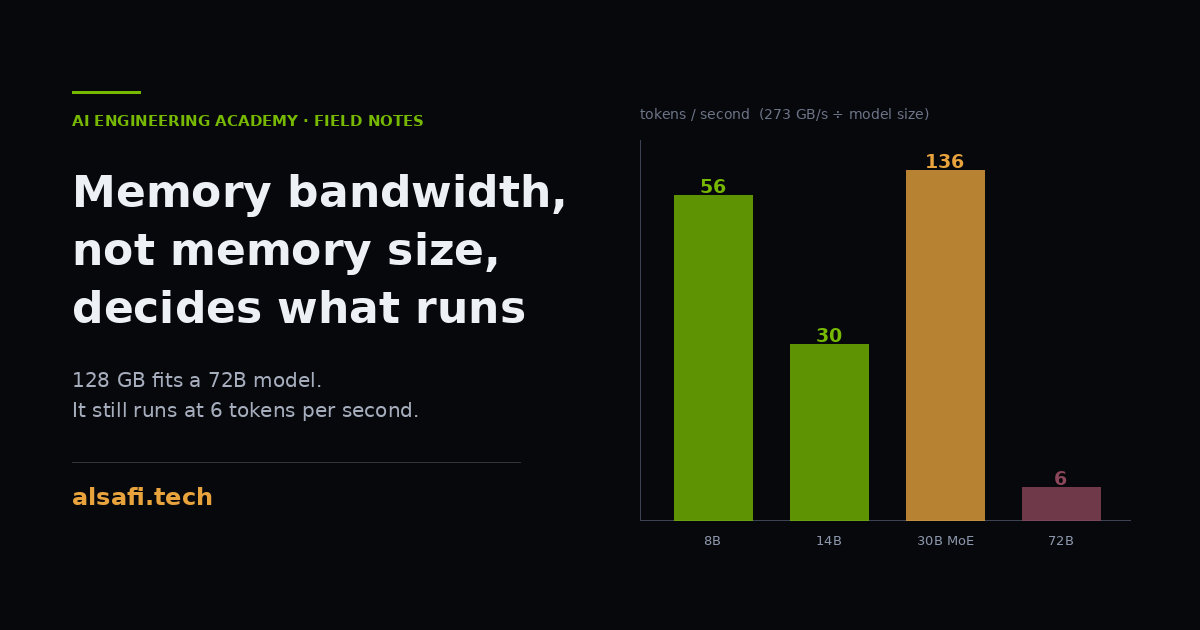
A DGX Spark holds 128 GB, so a 72B model fits. It still generates about five tokens per second. Here is the arithmetic that explains why, and what to run instead.
A transnational group working in applied AI, sovereign edge computing and industrial automation.
Newark, Delaware. The group's technology hub and vendor partnership entity. Member of NVIDIA Inception — the source of the academy's compute.
London. Intellectual property, research and publishing. Member of the Microsoft AI Cloud Partner Program.
Umm Al Quwain Free Trade Zone. MENA operations hub, licensed for AI development and AI education. Operator of the academy.
Partner programmes: NVIDIA Inception — access to compute infrastructure and the NVIDIA ecosystem. Microsoft AI Cloud Partner Program — publisher status in the commercial marketplace, through which graduates publish their own offers. RAKTN — regional technology partnership.
These programmes publish no public member directories, so confirmations are issued by letter on request: dev@hybt.ai.
AI Engineering Academy · Operated by AL SAFI FZE (Umm Al Quwain, UAE)
Curriculum and educational content by Digital Qazaqstan LTD (London) · UK Registered Learning Provider · UKPRN 10102276 · Company No. 17178943 · DIGITAL QAZAQSTAN® UK IPO No. UK00004263004, Class 42